May 19, 2026 • Celeste Morrow • 9 min reading time • Prices verified June 4, 2026
Mousse Format, Decoded: Why Bondi Sands, St. Tropez, and Coco & Eve Foam Differently
If you’ve ever switched self-tanning mousses and felt like you were working with an entirely different product category — one gliding on like whipped silk, the next dragging and drying before you’ve finished a knee — you weren’t imagining it. Mousse is one of the most popular formats in sunless tanning (the practice of getting a tan appearance without UV exposure, using a color-developing ingredient called DHA, or dihydroxyacetone), but the word “mousse” covers a surprisingly wide range of formulations. Some are light and almost watery inside the foam. Others are dense and richly conditioned. A few sit somewhere in between. The texture you get out of the mitt is a direct result of what’s inside the can — the propellant system, the base ingredients, the ratio of emollients to actives — and understanding those differences will change how you shop, how you apply, and how forgiving your results end up being.
This article breaks down why Bondi Sands, St. Tropez, and Coco & Eve foam the way they do, what the structural differences mean at application time, and how to match mousse architecture to your skin type and application confidence level.
| EDITOR'S PICKSt.Tropez Classic Bronzing Self… | Mid-tier[Loving Tan Deluxe Self Tanning…](https://www.amazon.com/dp/B00BOXSC5M?tag=greenflower20-20) | Budget pick[St Moriz Professional Medium Se…](https://www.amazon.com/dp/B01CGKQAIC?tag=greenflower20-20) | |
|---|---|---|---|
| Color Guide | Tinted | — | — |
| Size | 8 fl oz | 4 fl oz | 6.76 fl oz |
| Finish | Natural | Ultra Dark | — |
| Cruelty Free | — | ✓ | — |
| Key Ingredients | — | — | Aloe Vera & Vitamin E |
| Applications | — | Up to 5 | — |
| Price | $44.00 | $40.00 | $12.99 |
| See on Amazon → | See on Amazon → | See on Amazon → |
What Actually Makes a Mousse a Mousse (and Why the Internals Vary)
A self-tanning mousse is an emulsion — a blend of water, conditioning agents, and active tanning ingredients — that’s been aerated through a pressurized can using a propellant (typically a hydrocarbon blend or compressed gas). When the formula hits air, it expands into foam. But the foam you see is only the delivery vehicle. What matters is the liquid emulsion trapped inside the bubbles, and that’s where formulas diverge sharply.
The three variables that determine mousse behavior at application:
1. Water-to-emollient ratio. A high-water formula collapses quickly on the skin, absorbs fast, and gives you a short application window. This suits confident applicators who work quickly and want a lightweight, non-sticky finish. A higher-emollient formula stays wet longer, giving you more time to blend but also more margin for pilling if your skin wasn’t fully prepped.
2. DHA concentration and form. DHA (dihydroxyacetone) is the colorless sugar derivative that reacts with amino acids in the top layer of your skin to produce a browning effect — similar in chemistry to how cut fruit browns, as Healthline’s overview of DHA notes. Most consumer mousses sit in the 3–8% DHA range, but brands rarely publish exact percentages. Mousses that also include erythrulose (a slower-developing companion active) tend to produce a more gradual, less orange-prone result because erythrulose deepens over 24–48 hours rather than the 4–8 hour window typical of DHA alone. Paula’s Choice’s ingredient breakdown flags erythrulose as one of the most reliable anti-orange contributors in leave-on self-tanners.
3. Propellant and foam density. A denser propellant gas produces a thicker, longer-lasting foam that’s easier to scoop and portion. A lighter propellant delivers an airier, faster-collapsing foam that requires quicker hands. The density difference is partly why some mousses feel almost fluffy enough to hold shape on the back of your hand while others deflate the moment they leave the dispenser.
Bondi Sands, St. Tropez, and Coco & Eve: Where Each Formula Sits
Bondi Sands Ultra Dark Self Tanning Foam (~$20–22)
Bondi Sands is the clearest example of a high-water, fast-absorbing mousse architecture. Reviewers at Byrdie consistently describe the texture as light and slightly watery once dispersed on the mitt — it blends easily but requires a steady pace because the formula begins setting relatively quickly on contact with skin. This is a feature, not a flaw: that fast absorption is why Bondi Sands is often cited as a good training formula for intermediate applicators building speed and technique. The transfer window is narrow, but the learning loop is short.
The Ultra Dark shade delivers a strong result partly because Bondi Sands leans heavily on the cosmetic bronzer (the instant color guide that shows you where you’ve applied) as well as DHA development. This dual-action approach is common in Australian self-tan brands, per Allure’s self-tanner guide, and it explains why the color you see at application looks almost alarmingly deep before rinsing — a lot of that initial color is the bronzer, not the developed tan.
Tradeoff to name explicitly: Because the base is leaner on conditioning agents, dry or textured skin tends to grip unevenly. If your prep (exfoliation, barrier moisturizer on knees and elbows) isn’t dialed in, Bondi Sands will find every dry patch. On smooth, well-prepped skin, it’s a reliable and genuinely budget-efficient option.
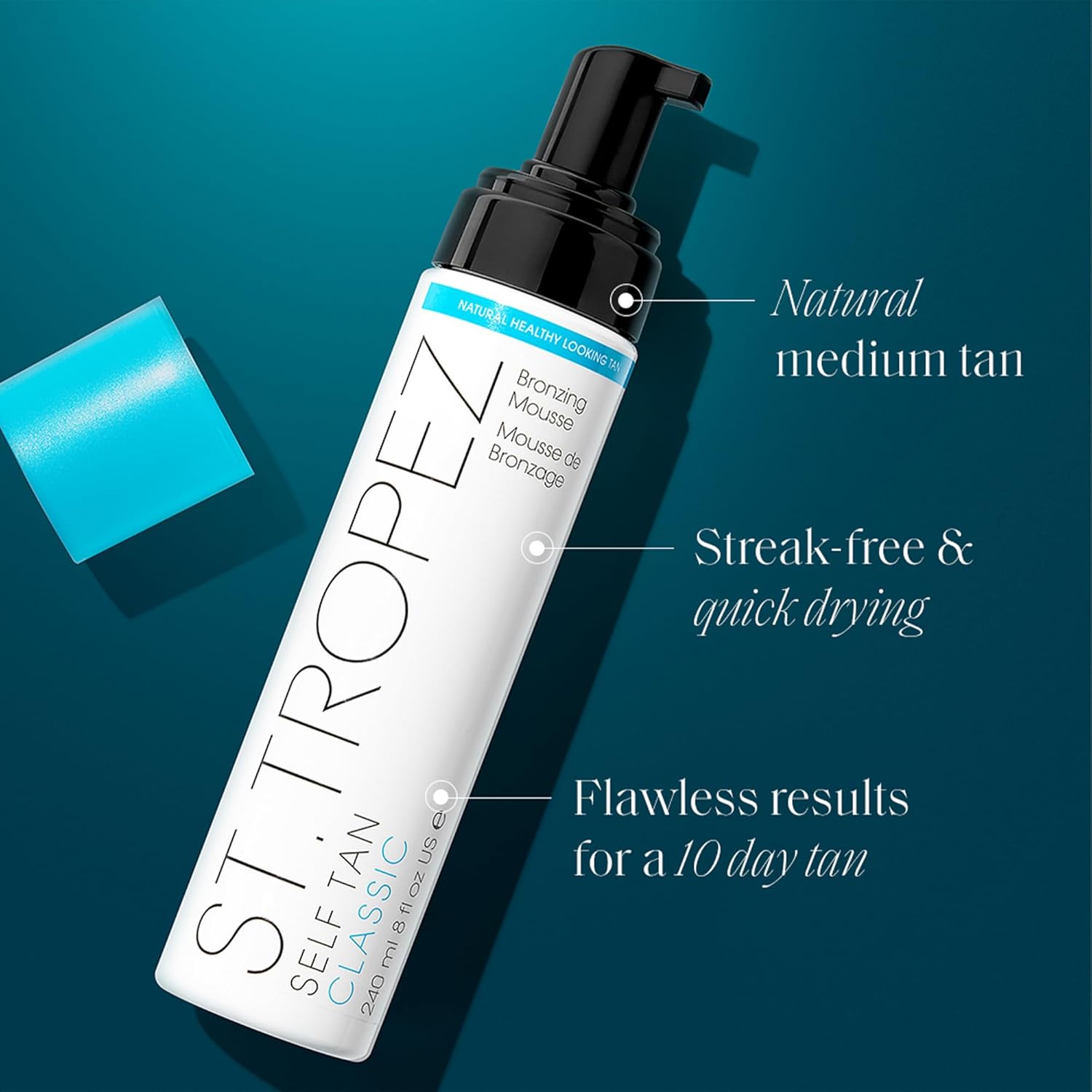
St. Tropez Self Tan Classic Bronzing Mousse (~$40–45)
St. Tropez occupies the middle tier structurally — a balanced emulsion that leans slightly more conditioning than Bondi Sands but stays breathable enough to avoid tackiness. The foam is notably denser and more stable, meaning you get a longer application window and the product stays workable on the mitt for several additional seconds. For anyone covering a full body application in one session, that extended working time is functionally significant.
The color technology in the Classic formula uses a cooler-undertone DHA blend that’s become the standard many enthusiasts use as a baseline comparison for “what doesn’t go orange.” Reviewers at Byrdie and editorial coverage in Allure’s self-tanner roundups both consistently note the formula’s neutral-to-warm result across a range of skin tones, though it still skews slightly warm on very fair complexions over repeated applications.
St. Tropez also benefits from one of the better-developed cosmetic bronzer systems in the mid-range: the guide color is more muted (closer to true tan than orange), which makes post-application inspection easier before the DHA develops. This matters at the intermediate level because you’re still calibrating application technique, and a more neutral guide color is honest feedback.
Tradeoff to name explicitly: At the $40–45 price point, you’re paying partly for the brand architecture and partly for genuinely better emollient integration. The formula is more forgiving than Bondi Sands on imperfect prep, but it does require a clean, dry mitt — the denser foam can overload a damp applicator and cause uneven release.
Coco & Eve Sunny Honey Bali Bronzing Bundle (~$50–55)
Coco & Eve operates in a structurally distinct category: this is an emollient-forward, conditioning-heavy mousse that reads almost like a hybrid between a traditional self-tanner and a body treatment. The formula includes actives like fig extract and coconut-based conditioning agents that noticeably extend the blend window and leave the skin feeling genuinely hydrated during and after application. Harper’s Bazaar’s coverage of the formula highlights this skin-treatment positioning as a differentiator from drier, faster-absorbing competitors.
The result is a mousse that’s more forgiving for slower applicators, particularly on limbs with irregular surface texture (think elbows, knees, backs of arms). Because the emollient base keeps the formula workable longer, you have more time to feather edges and correct before the product begins setting.
The color payoff sits in a warm-to-golden range — reviews consistently describe the result as olive-tinted and luminous rather than bronze-brown, which makes Coco & Eve a strong match for medium-to-deeper skin tones seeking depth without heaviness. On very fair or cool-undertone skin, the warmth can read slightly amber over multiple applications.
Tradeoff to name explicitly: The conditioning richness that makes Coco & Eve forgiving is the same property that demands more careful prep and drying time between application and sleep. If the formula doesn’t fully absorb before contact with sheets or clothing, transfer is more pronounced than with leaner mousses. The recommended 6–8 hour develop time is worth taking seriously here.
By the Numbers
| Formula | Price (approx.) | Foam Density | Blend Window | Best-fit skin prep level |
|---|---|---|---|---|
| Bondi Sands Ultra Dark | ~$21 | Light/fast | Short | Fully prepped, smooth |
| St. Tropez Classic | ~$43 | Medium/stable | Medium | Moderate prep OK |
| Coco & Eve Sunny Honey | ~$52 | Rich/slow | Extended | Forgiving on drier skin |
The Application Variable Nobody Talks About Enough: Mitt Load
One consistent pattern across aggregated reviews of all three formulas: the most common errors aren’t formula-related — they’re mitt-related. Specifically, overloading the mitt with product at the start of each body section and underloading it for blending passes.
A useful calibration, based on community-consensus guidance compiled in Byrdie’s application technique features: for the thigh and shin combined, most mousses require two or three pea-to-walnut-sized pumps of foam, not one large scoop. Loading a smaller amount per section and blending immediately gives you more control over streak formation than any formula difference between brands.
The corollary: the forgiving blend window of Coco & Eve gives you more margin to correct overloading errors. The tighter window of Bondi Sands punishes them faster. This doesn’t make Bondi Sands inferior — it makes it more technique-dependent, which is worth naming as you make a purchasing decision.
Decision Frame: If X, Then Y
You’ve read the architecture. Here’s how to apply it:
If your skin is dry or you frequently get patchy results on knees, elbows, or shins: Coco & Eve’s emollient-heavy base is structurally more forgiving. The extra conditioning buys you time and minimizes dry-patch grip. The investment of ~$52 delivers genuine skincare co-benefits that leaner formulas don’t.
If you’re building speed and technique and want fast feedback loops: Bondi Sands’ short blend window trains precision more efficiently than conditioning-heavy formulas. At ~$21, the cost-per-application math also allows for more frequent practice sessions without budget anxiety.
If you’re in the middle — moderate prep consistency, intermediate technique, want a reliable color payoff without orange risk: St. Tropez Classic is the formula the intermediate tier keeps returning to for a reason. The balanced emulsion, stable foam, and cooler DHA profile address the widest range of skin conditions without demanding perfect technique or perfect prep.
If you’re debating between formats rather than brands: The mousse category in general rewards applicators who work consistently and quickly. If you prefer a more leisurely pace or are applying to multiple body areas solo, an oil-serum hybrid (like Tan-Luxe The Body) may ultimately suit your workflow better than any mousse — but that’s a separate format conversation worth a dedicated breakdown.
The formula differences between these mousses are real and structural. Understanding them won’t replace technique, but it will stop you from blaming the wrong variable when something goes sideways — and that’s the kind of diagnostic clarity that actually upgrades your routine.